
Pain de Campagne With Lots of Whole Wheat Flour. Generously dust two lined bannetons or towel-lined large bowls with whole wheat flour. Shape the loaves into tight rounds (boules), place them seam-side up into the prepared bannetons or bowls, and cover them with a plastic bag or shower cap. Pain de campagne (French: "country bread") is a traditional French sourdough bread loaf made with a mix of refined flour, and whole grain wheat and rye flours.
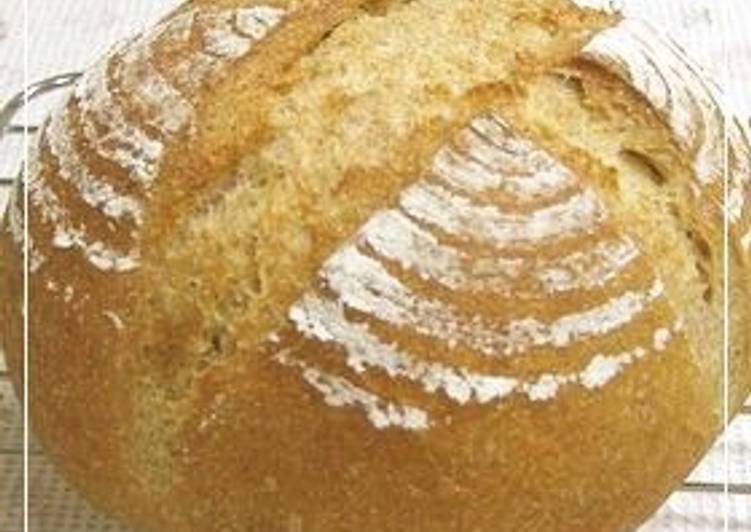
You can have Pain de Campagne With Lots of Whole Wheat Flour using 9 ingredients and 15 steps. Here is how you cook that.
Ingredients of Pain de Campagne With Lots of Whole Wheat Flour
- Prepare 100 grams of ◆Bread (strong) flour.
- You need 100 grams of ◆Whole wheat flour (finely milled type).
- It’s 10 grams of ◆Sugar.
- Prepare 3 grams of ◆Salt.
- You need 3 grams of ◆Dry yeast.
- It’s 130 grams of ◆Lukewarm water (use cold water in the summer).
- You need 1 of Joshinko or bread flour.
- Prepare 1 of Stainless steel bowl.
- You need 1 of Banneton (round bread rising bowl).
Pain de campagne traditionally has a small percentage of whole wheat flour and can be made using commercial yeast or a sourdough leaven. The dough is exceptionally easy to shape so you have a lot of choice in what you do with it. I opted to mostly make rolls with the bread and then also a few baguettes (not pictured). There were American whole wheat breads with lots of sugar and fat.
Pain de Campagne With Lots of Whole Wheat Flour instructions
Combine the bread and whole wheat flours, and sift twice..
Put all the ◆ ingredients in a bread machine, and start the "dough only" program. After 6 to 7 minutes stop the machine, take the dough out into a bowl, and round it off lightly..
Cover with plastic wrap and use your oven's "bread rising" setting to let it proof for 30 to 40 minutes at 35°C, or until it has doubled in volume (1st rising)..
After the 1st rising has completed, round off the dough again, cover with plastic and leave to rest for 20 to 30 minutes..
Dust the banneton with joshinko or bread flour using a tea strainer..
Deflate the rested dough, and round it off again so that it has a smooth, taut surface. Put the dough in the banneton seam side up, and cover with plastic wrap..
Let it rise (2nd rising) at 35°C for 25 to 30 minutes, until it has increased to 1.5 times its original size. Preheat the oven, including the baking sheet and the stainless steel bowl, to 250°C..
Cover the banneton with a sheet of kitchen parchment paper, and invert the dough onto the paper..
Slash the top of the loaf with a moistened knife about 5 mm deep..
Take the stainless steel bowl out of the oven, and put the dough, paper and all, on the baking sheet. Invert the bowl over the loaf..
Lower the oven temperature to 210°C and bake for 20 to 25 minutes. Take the bowl off 10 minutes in. If it looks like the top is browning too fast, cover it with aluminum foil..
When the bread is baked, cool it on a rack and then store in a plastic bag to prevent it from drying out..
I used a 24 cm diameter, 8 cm deep stainless steel bowl. This bowl worked fine even when the dough rose up in the oven..
It looks like this when sliced. It's a deeply flavored bread with lots of whole wheat..
I made this version with 100 g each of bread and cake flour, 50 g of whole wheat flour, 162 g of lukewarm water (cold water in the summer), and the same amount of the other ingredients as in the recipe above..
There were German and Polish whole wheat breads well suited for a spread of herring or smoked meats with mustard. French country bread, or pain de campagne, is a combination of white and whole wheat flour, and is typically made with sourdough, but can also be made with baker's yeast. I have a lot of French country bread recipes on this blog, including this one, that takes a couple of days to make, this one , that requires a three to four hour rise, and. Add the remaining ingredients and mix until there are no remaining dry pockets of flour. If mixing by hand, use a dough scraper to blend the dough and break down the levain.
